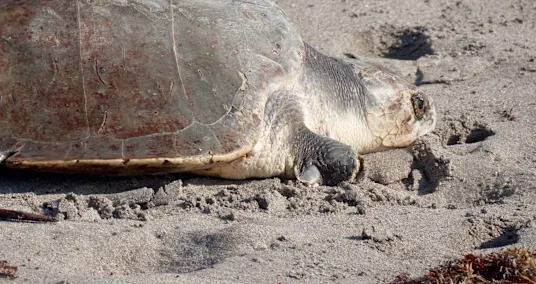
JUNO BEACH, Fla. (AP) — The veterinary staff at a Florida sea turtle hospital is getting help from space to monitor the animals they have rehabilitated. They're particularly interested in amputees.
Using satellite tracking devices in a collaboration between the Loggerhead Marinelife Center and the Smithsonian Conservation Biology Institute, scientists are learning how well sea turtles can survive in the wild after losing a limb.
Amelie, a Kemp's ridley sea turtle who lost her right forelimb to a predator — most likely a shark, the center said — was taken to the beach on Wednesday for her highly anticipated release. The turtle paused for about 30 seconds, then slowly made her way into the Atlantic Ocean as onlookers cheered.
Amelie had been rescued and brought to the center by the Inwater Research Group in Port St. Lucie, Florida, seven weeks earlier after a traumatic amputation. She underwent surgery to clean and close the wound, and was treated for pneumonia while in a tank at the center. When veterinarians deemed her healthy enough to return to the sea, they glued a tracking device to her shell.
An ultrasound confirmed that Amelie is developing eggs, giving researchers another reason to track her movements.
Kemp's ridley turtles, the rarest of sea turtle species, are more typically found on Florida's Gulf Coast, so treating Amelie was especially significant, said Andy Dehart, the center's president and CEO.
Amelie is actually the fourth amputee sea turtle being tracked by the enter, Loggerhead research director Sarah Hirsch said. They include a three-limbed turtle named Pyari who has traveled nearly 700 miles since her release in January, her tracker shows.
“We do know that they can be successful in the wild because we have seen them on our nesting beaches, but we really want to understand their dive behaviors, how they’re migrating once they’re back in the wild," Hirsch said.
The satellite tags have a saltwater switch that detects when the turtle comes up to the surface to breathe, triggering the transmission of data to the satellites. Their location appears online after a 24-hour delay. To view Amelie and other turtles tracked for various research projects, visit the Loggerhead website.
“They’ve been through a lot," Hirsch said. "They’ve gotten a lot of medical care here, and to see them be able to go back out and contribute to the population is really rewarding.”
To view Amelie and other turtles tracked for various research projects, visit the Loggerhead website.
—
Frisaro reported from Fort Lauderdale, Florida.
latest_posts
- 1
 'Israel has the right to continue its attacks,' Lebanese Foreign Minister announces
- 2Bayer reports positive results for blood thinner after 2023 setback
- 3Revealing the Incomparable Realms: An Excursion through Power and Inheritance
- 4Is Trump going to war with Venezuela?
- 5Why are malnutrition deaths soaring in America?


- FBI arrests Brian Cole Jr. in Jan. 6 pipe bomb investigation, ending 5-year hunt
- Louisiana seeks California doctor’s extradition, testing the limits of shield laws
- Keep It Cool: Uncovering Famous Fridge Brands for Each Home
- Make your choice for the sweet that transports you to its nation of beginning!
- India’s delayed climate plan sets modest emission target
- Archaeologists uncover details about the Hjortspring boat's origins
- The Appearance of Experience: Embracing the Reduced Portage Horse
- A Sweet Choice: Pick Your #1 Cake!
- 25 Most Beautiful Villages in France You Can Actually Visit