When you buy through links on our articles, Future and its syndication partners may earn a commission.

Russian state-owned Energia rocket company has secured a patent for a novel spacecraft architecture designed to generate artificial gravity, a capability which could provide a huge boost for long-duration crewed missions.
A report from Russian state media outlet TASS, which obtained the patent, states that the rotating system is designed to generate a gravitational force of 0.5g, or 50% of Earth’s gravity. The patent documentation includes illustrations of a notional space station structure with a central axial module with both static and rotating components, with modules and habitats connected by a hermetically sealed, flexible junction.
The radially attached habitable modules would be rotated around this axis to simulate gravity for the crew by producing an outward-pushing centrifugal force. These would need to rotate about five revolutions per minute, and have a radius of 131 feet (40 meters) in order to produce 0.5g. A space station of that size would require multiple launches with each module that would then be assembled in orbit.
The documentation notes the disadvantage of the need for spinning and coordinating the rotation of transport ships to dock with the station, which it notes reduces the safety of using such a station.
Generating artificial gravity could have profound impacts for crews on long-duration space missions, whether in low Earth orbit on interplanetary voyages into deep space. Exposure to microgravity has numerous impacts on astronauts, including muscle atrophy and bone density loss.

NASA has produced concepts such as the rotating wheel space station concept Nautilus-X, while, more recently, commercial firm Vast has said it will pursue artificial gravity stations.
Russia did not indicate timelines for such a project nor resources to back its development. The patent does however indicate interest in the concept of artificial gravity at a time when the end of the International Space Station (ISS) is approaching and new national and commercial station plans are moving forward.
Currently, NASA and Roscosmos plan to deorbit the ISS in 2030, using a modified SpaceX Dragon capsule to push the station down into a fiery death over the Pacific Ocean. Russia has committed to stay aboard the ISS until 2028.
latest_posts
- 1
 Mars spacecraft images pinpoint comet 3I/ATLAS's path with 10x higher accuracy. This could help us protect Earth someday
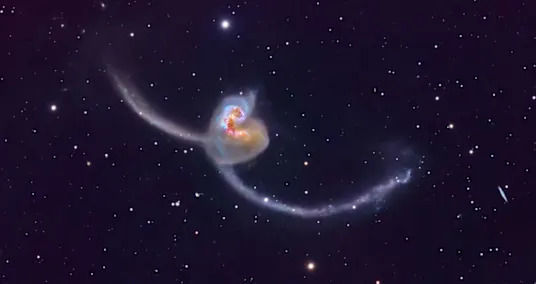
- 2Astrophotographer captures spectacular photo of Antennae Galaxies dueling in deep space
- 3Nuno Loureiro, MIT physicist, fatally shot at home; police investigate
- 4'Stranger Things' Season 5: What's going on with Will Byers? That shocking Volume 1 plot twist, explained.
- 5Kidneys from Black donors are more likely to be thrown away − a bioethicist explains why



- Old photos misrepresented as aftermath of political party supporters' brawl in Bangladesh
- Authorities arrest 7 bodyguards in connection with a Mexican mayor's assassination
- Mom warns of Christmas gift hazard as daughter recovers in hospital
- Unpaid caregiving work can feel small and personal, but that doesn’t take away its ethical value
- 6 Asian Urban areas to Visit
- These 2 moon rovers used cameras and lasers to hunt for simulated water ice — and one looks like WALL-E
- Woman leaves bachelorette trip after trusting her gut about sketchy men partying it up with friends
- Are IDF reservists properly armed during post-war operations?
- Blue Origin launches New Glenn rocket on company's first NASA-scale science mission