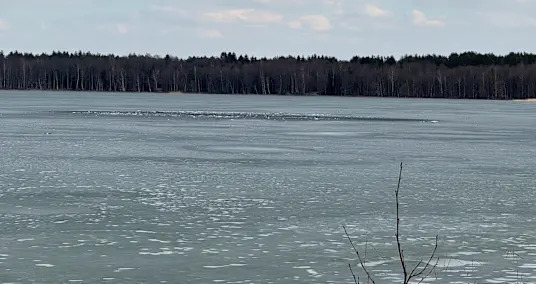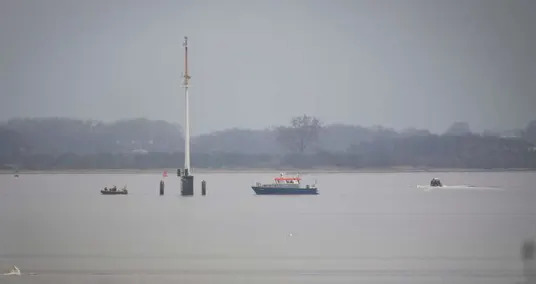
A humpback whale stranded for days off Germany's Baltic coast has freed itself late on Saturday after getting stuck on another sandbank, a spokesman for the Mecklenburg-Western Pomerania Ministry of the Environment said.
The whale was being accompanied by the water police, who are trying to follow it, Claus Tantzen said, adding that, since the waters in the area are very shallow, the animal may get stuck again.
The unlucky animal has garnered massive media attention since it ran aground on a sandbank early on Monday off Germany's Timmendorfer Strand resort, near the city of Lübeck.
Days of efforts to free the 12- to 15-metre whale proved unsuccessful until rescuers dug out a channel in the surrounding sand using a floating excavator on Thursday, allowing the whale to swim free the following night.
However, environmentalists and marine experts had feared that the whale could potentially get stuck again, as it was spotted heading back towards shallower water following its release.
Those concerns became reality on Saturday, with the whale spotted stranded on a sandbank in the Bay of Wismar, some 40 kilometres to the east of Timmendorfer Strand, according to Greenpeace.
Incidentally, it was found beached off the unpopulated island of Walfisch, which translates as whale in English.
"After managing to free itself from its [earlier] predicament, the whale was spotted again at midday today in the Bay of Wismar near the island," the state's Environment Ministry said at the time.
Continued great interest
Following initial sightings on Saturday, a plethora of concerned officials, scientists and activists had headed to the Bay of Wismar in case the creature needed assistance again.
Large whales such as humpback whales are not native to the Baltic Sea but occasionally end up there after following schools of fish in search of food, for example.
According to experts, underwater noise could also play a role in this whale's presence in the Baltic Sea.
Biologists had been hoping the whale would make its way back west towards the North Sea, which would have allowed it to reach the open waters of the Atlantic Ocean.
Following its initial release, conservation groups used dinghies to form a kind of blockade to prevent it from entering shallow water again, trying to guide it further into the deeper waters of the Baltic Sea.
However, the whale was soon spotted further east, off the coast of the Mecklenburg district.
According to the Institute for Terrestrial and Aquatic Wildlife Research, it was impossible to attach a tracking device to the whale because its skin is too diseased.


latest_posts
- 1
 Your guide to how to safely thaw and cook your Thanksgiving turkey this year, according to experts
- 22023's Best 10 Cell phone Advancements You Can't Miss
- 3Figure out How to Consolidate Cutting edge innovations in Senior's SUVs
- 4Ariana Grande to host 'Saturday Night Live' Christmas show with Cher as musical guest, returning after nearly 40 years
- 5We tasted one of the 10,000 Hershey's Dubai chocolate bars being resold on eBay. Is it worth the hype?


- These 45 exoplanets may be the best places to search for alien life
- 'I carried my wife's body for an hour and a half' - BBC hears stories of protesters killed in Iran
- 'People We Meet on Vacation' is the 1st of many Emily Henry adaptations: What other books turned movies to look forward to
- Exclusive-Drugmakers raise US prices on 350 medicines despite pressure from Trump
- Nearly half of reindeer have been wiped out and armadillos are in Iowa. Here’s how animals are weathering warming holidays
- Home Machine Basics: An Exhaustive Purchasing Guide
- The Best Computer games for Multiplayer Fun
- Ukrainian drones hit all three Baltic States − did Russia redirect them?
- The race is on to turn your body into a GLP-1 factory